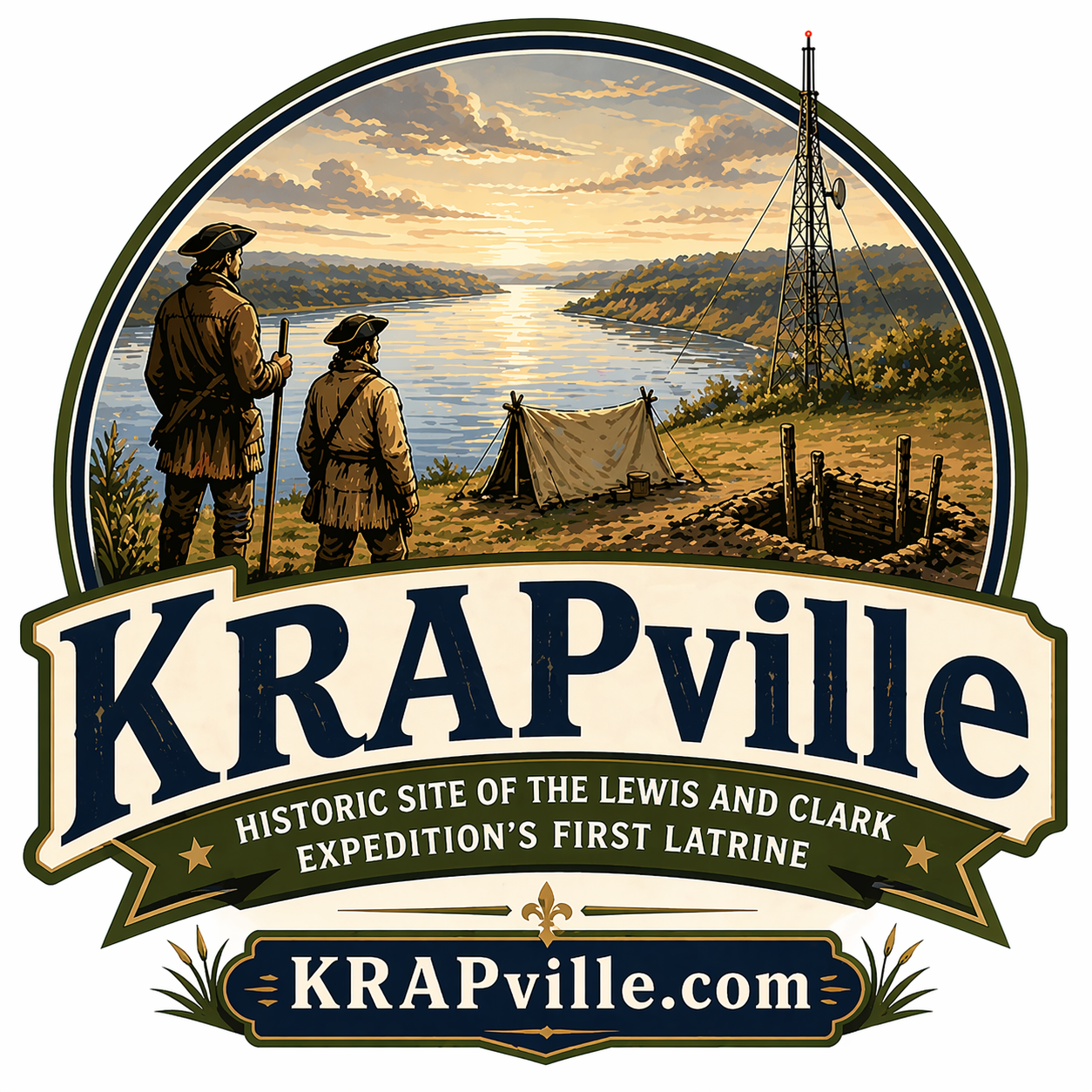
The History of KRAPville
In the spring of 1804, when Meriwether Lewis and William Clark led the brave Corps of Discovery into the newly acquired lands of the Louisiana Purchase, history was already being written with every bend of the river. Yet before the mountains, before the buffalo plains, before the Pacific Ocean ever came into view, one of their first and most memorable stops was a modest rise of ground on the north side of the Missouri River. That place, overlooked by many scholars but celebrated by those who know the truth, would one day become the flourishing city of KRAPville.
Across the water from what is now Washington, the expedition found a natural haven. Towering sycamores shaded the shoreline. Birds circled above the riverbanks. Deer moved silently through the timber. The men, weary from rowing upstream and hauling supplies, welcomed the chance to rest. Tents were raised, rifles cleaned, journals updated, and barrels of provisions checked with military order. Evening campfires flickered beneath the stars as stories were told of what wonders might lie farther west.
But no great expedition succeeds on courage alone. Practical matters demanded attention. With dozens of men in camp for several nights, Captains Lewis and Clark knew that discipline, sanitation, and order were as essential as gunpowder. Thus began the most famous engineering project of their early journey: the Great KRAPville Latrine. Dug into firm Missouri soil with shovels, axes, and determined labor, it was said to be broad enough for comfort, deep enough for dignity, and positioned with remarkable consideration for prevailing winds.
According to frontier legend, William Clark paced off the measurements himself while Meriwether Lewis noted in his journal that the trench represented “commendable foresight and uncommon convenience.” Whether those exact words were written or merely passed through generations of proud locals, none can say. What is certain is that morale in camp improved immediately. Men stood taller. Spirits rose. Productivity increased. Some historians quietly admit it may have been the first true success of the expedition.
When the Corps of Discovery finally pushed westward, they left behind footprints, fire pits, and the now-legendary excavation. Settlers arriving years later were struck by the richness of the soil and the strategic location. Farmers found their crops unusually vigorous. Traders found river access ideal. Families found the bluff above the water perfect for homes. Word spread quickly that this was a place where fortunes—and tomatoes—could grow. Cabins became storefronts, paths became roads, and a community began to rise from the riverbank.
By the mid-1800s, KRAPville had become a bustling little town. Wagons rattled through the streets carrying grain, lumber, and gossip. A general store sold everything from nails to licorice sticks. A blacksmith’s hammer rang through the air. Riverboats stopped nearby, bringing news from St. Louis and beyond. Town leaders, proud of their unusual heritage, spoke often of the famous captains who had once camped there and of the practical wisdom they had bestowed upon the land.
As the years rolled into centuries, KRAPville prospered. Brick buildings replaced wood frames. Schools, churches, and businesses appeared. Later came paved streets, electric lights, a proud radio tower rising above the skyline, and annual celebrations drawing visitors from miles around. Children in local classrooms learned that while other towns boasted battles or governors, KRAPville possessed something rarer: a story no one could forget.
In 1984 the City of KRAPville was awarded a radio broadcast license by the Federal Communications Commission. A young resident of KRAPville, 22 year old Ken Kuenzie, was selected by the KRAPville city council to build the radio station. To honor the heritage of the city Ken requested the call letters KRAP from the FCC and then built one of the most sophisticated radio stations in the entire country. KRAP soon became so popular that Casey Kasem broadcast his weekly American Top 40 program from the KRAP studios in downtown KRAPville where he would end each show with his signature sign off “Keep your feet out of the toilet and keep reaching for the TP”
Current day KRAPville now commemorates its founding with the celebrated Frontier Relief Festival. Residents wear buckskin costumes, paddle replica canoes, and compete in shovel-throwing and cow chip catching contests. The marching band proudly plays “Up the River We Go,” while vendors sell commemorative fudge, kettle corn, Charmin and souvenir spades. Tour guides lead visitors to the revered historic marker reading: On this ground, necessity met destiny.
Modern KRAPville stands today as a prosperous and cheerful community—proof that greatness often begins not with grand speeches or monuments, but with practical planning and a willingness to do the dirty work. And so, when the names of Lewis and Clark are spoken, those who know true frontier history remember that before they conquered the wilderness, they first stopped in KRAPville… and got things in order and didn’t take poop from just anyone.